PROJECT BRIEF
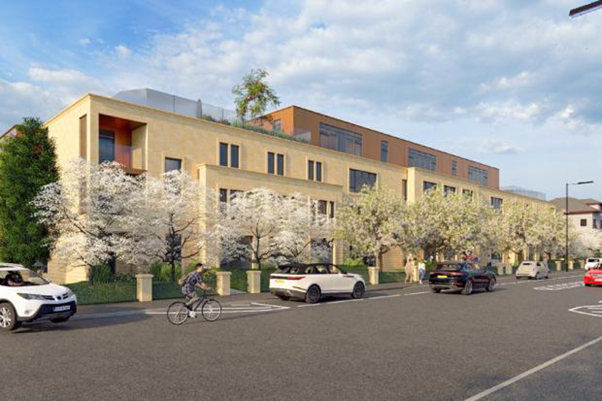
Roger Bullivant Limited (RBL) was employed by Northcare (Scotland) Ltd to provide a piling solution for Cleveden Suites, a new luxury care home in Glasgow’s West End. The development will provide much needed accommodation for the city’s population requiring care provision, offering residents a high quality living environment. RBL worked closely with the client and scheme engineer to develop a programme efficient and sustainable piling solution for this brownfield development.
The team provided early technical assistance to understand the ground conditions, site constraints and surrounding infrastructure. Based on their findings, RBL submitted a proposal to install Continuous Helical Displacement (CHD) Piles. This solution provided measurable sustainability benefits over a comparative CFA alternative, assisting with RBL and the project’s sustainability goals.
KEY ISSUES
The ground conditions on site comprised an upper covering of made ground overlying initially firm to stiff, becoming very stiff clays (glacial till). Underlying the glacial till, bedrock described as weak mudstone and strong siltstone was encountered below the site.
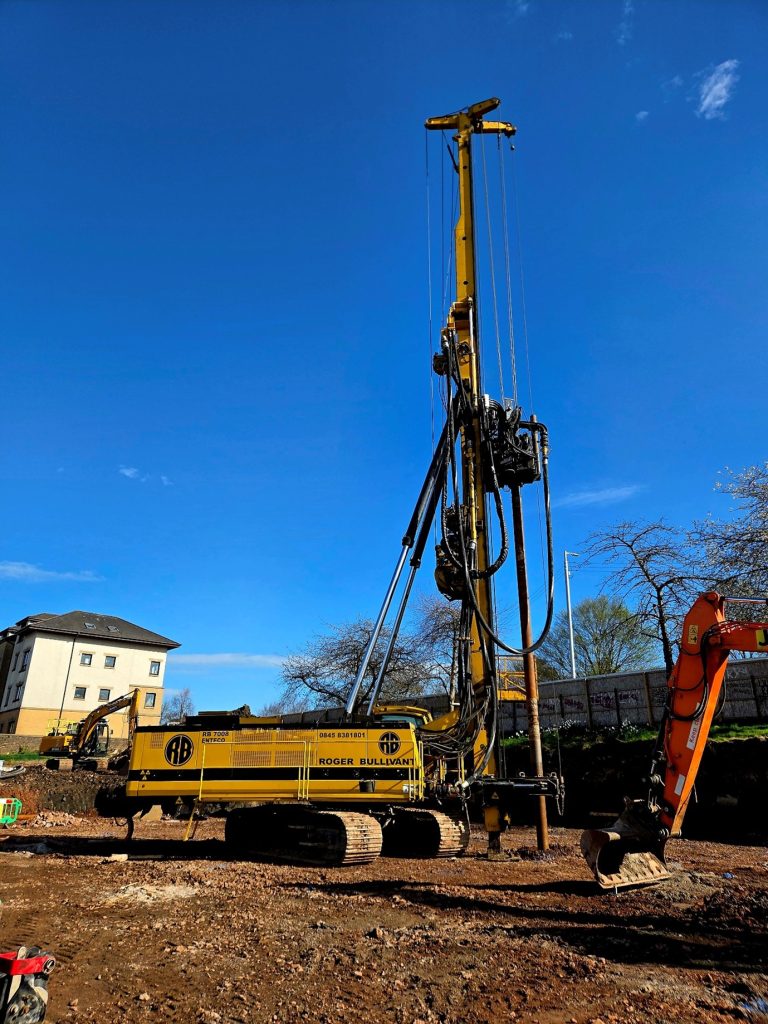
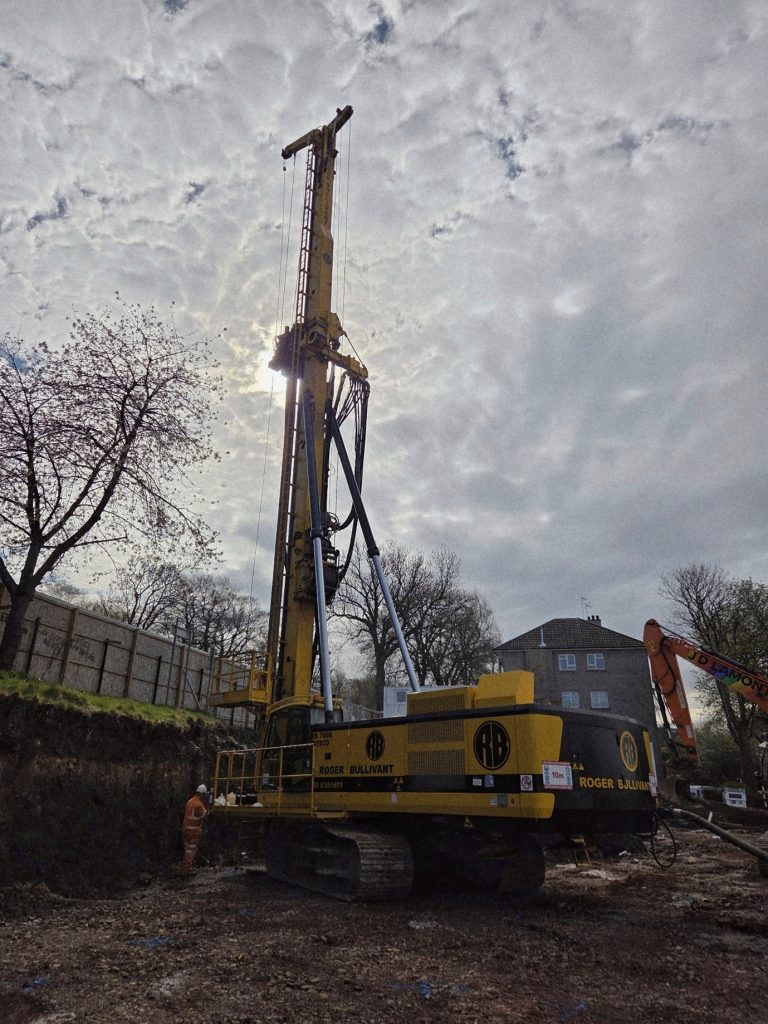
Due to the site’s varied levels, ground levels were subject to a significant cut exercise to form the lower ground level. This caused various logistical challenges to allow plant and materials to be delivered and operate circa 4m below street level.
To to meet the required construction programme a rapid turnaround was required from tender enquiry to start on site. RBL worked diligently alongside Northcare (Scotland) Ltd and their scheme engineer to agree design and procure materials for a prompt site start.
A disused rail tunnel (Balgray Rail Tunnel) runs below and adjacent to the development. Pile depths in the area of the tunnel had to be limited to a maximum depth of 7m to ensure a minimum 5m cover between the toe of the piles and the crown of the tunnel.
In order to ensure all stakeholders were satisfied with proposals, RBL verified the pile design by means of a static load test on working piles in Phase 1, negating the need for further verification in the future phase.
Piles required to be designed for various combinations of compression, tension and lateral loads. RBL accommodated a wide range of load combinations within the design and utilised the flexibility of off-site fabrication of pile reinforcement.
SOLUTION
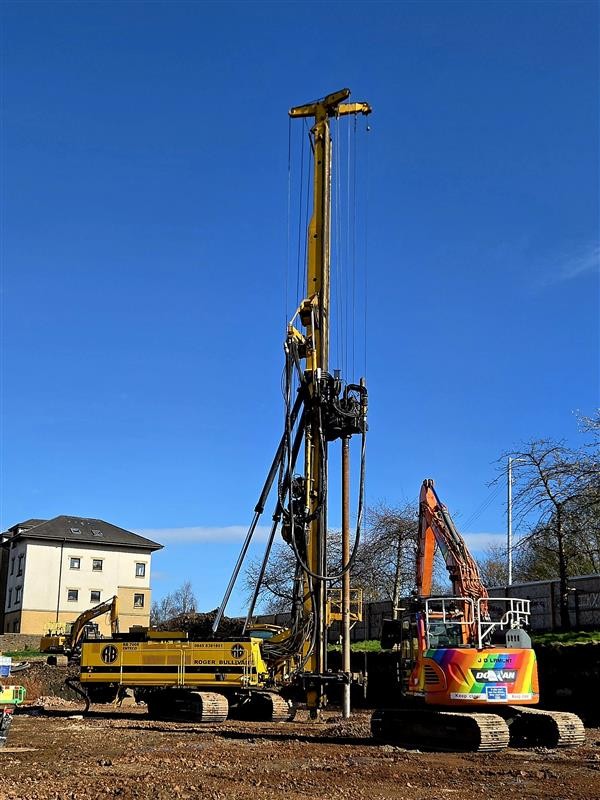
- RBL and Northcare (Scotland) Ltd agreed on a multi-visit strategy to effectively deliver the piling package whilst allowing follow on works to progress in a timely manner. RBL employed 1 No. Enteco 7000-series rig in to complete the Phase 1 piling operations.
- The location of the Balgray Rail Tunnel was a key consideration when proposing CHD piles for the project. Driven piles were considered unsuitable for the site due to proximity of neighbouring residential and commercial properties and a secondary school; therefore a low vibration / noise option was necessary. Through detailed design, RBL proposed our CHD pile which was 35-50% shallower than an equivalently sized CFA pile due to its enhanced load bearing capacity. This allowed the scheme engineer to progress with piles around the rail tunnel as per their original design intent with no change to the scheme or programme delays attributed to redesign.
- Opting for our CHD pile also yielded significant sustainability benefits for the project, with savings of approximately 100tCO²e versus an equivalently sized CFA pile.
- All pile reinforcement was fabricated off-site and incorporated debonding foam to assist follow on trades.
- Piles were designed in accordance with British Standards with maximum design loads of 450kN compression, 50kN tension and 10kN lateral. The design was validated by a static load test on a working pile during the main works. The pile test demonstrated compliance with the project specification.